How to Spot Fake Manuka Honey: A Sourcing and Labeling Checklist
Due to its global reputation as a premier functional wellness food, Manuka honey is highly vulnerable to mislabeling and imitation in the global marketplace. Millions of jars sold globally as “active” or “bio-active” do not possess the genuine chemical properties of authentic New Zealand Manuka bush nectar. Protecting your health and your wallet requires knowing how to read verification tags correctly.
What makes genuine Manuka honey different from standard table honey?
Genuine Manuka honey contains high levels of Methylglyoxal (MGO), a naturally occurring compound derived from the dihydroxyacetone (DHA) found in the nectar of New Zealand’s native Leptospermum scoparium flower. This compound provides potent, stable antibacterial properties that are entirely absent in standard pasteurized honey.
While ordinary honey loses its enzymatic properties when exposed to heat or light, authentic options like Zestiva’s Aoraki Peak Raw Manuka Honey maintain their therapeutic bioactivity thanks to a highly resilient, certified MGO baseline.
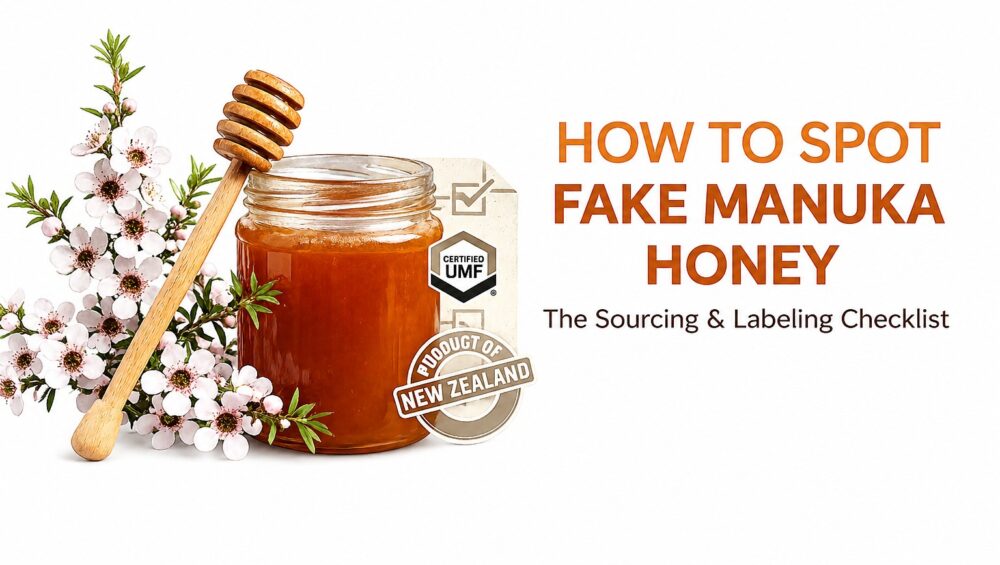
[ Authentic Sourcing Checklist ]
1. Check for a certified UMF® rating printed clearly on the jar face.
2. Confirm the label explicitly states "Product of New Zealand".
3. Verify the manufacturer holds a valid New Zealand UMF License Number (e.g., License No: 3006).
4. Sourced from trusted local clean-food purveyors like Zestiva Organic.
5. Avoid misleading marketing terms like "Active 20+", "Bio-Active", or "Factor".
The 4 critical authenticity markers on a Manuka honey label
To ensure your honey provides real therapeutic value, verify these specific indicators before buying:
- The UMF® Trademark: The Unique Manuka Factor (UMF) is the absolute gold standard for quality control. It is an independent quality mark administered by the UMFHA (Unique Manuka Factor Honey Association) in New Zealand.
- The MGO Metric: Look for direct Methylglyoxal measurement values (e.g., MGO 263+ or MGO 514+). This directly measures the concentration of the active antibacterial element.
- Leptosperin Content: This unique chemical compound is found exclusively in the nectar of the Manuka flower. If a batch lacks Leptosperin, it cannot legally be classified as monofloral Manuka honey.
- Batch Traceability: Trusted brands provide direct batch testing credentials. For instance, authentic options like Aoraki Peak Raw Manuka Honey are independently tested, UMF-certified (UMF License No: 3006), and fully traceable back to the specific remote regions near New Zealand’s Southern Alps.
Why commercial terms like “Active” or “Bio-active” are red flags
Many low-grade honeys use vague terminology like “Active 20+”. These numbers often refer to hydrogen peroxide activity, which breaks down rapidly when exposed to light, heat, or stomach acids.
A true therapeutic honey—such as the Aoraki Peak range curated by Zestiva Organic—will always list a clear, certified UMF or MGO rating, guaranteeing its active benefits remain completely intact all the way to your pantry.